Global Fourth World COVID-19 Pandemic Risk Assessment
Coronavirus (COVID-19) In Indian Country USA
The Center for World Indigenous Studies is coordinating, planning and organizing support for tribal and urban Indian communities that now face the wave of coronavirus infections across the United States. CWIS is taking action to prevent and reduce the dangerous effects of the COVID-19 pandemic in Indian Country. CWIS is working with a task force of experts to gather information (research), develop policy analysis and provide recommendations for a program of action congruent with the specific needs of diverse communities.
COVID-19 Risk to Indian Country
In March 2020 the level of infection and risk of infection in Tribal and Urban Indian communities suddenly increased. The infections grew quickly from 1 infection in and around a tribal community to many more where the Navajo Nation alone documented as many as 240 infected persons and 11 who died by 6 April 2020.
The map below illustrates the areas that have experienced at least one infection and the red dots indicate actual reservation areas where the risk of infection suddenly grew to larger numbers. Indian Country in remote areas and in the Urban Indian communities is now very much enveloped in the COVID-19 epidemic.
Individuals in Indian Country who are among the 11% or higher proportion of the population who suffer from chronic diseases (diabetes, heart disease, kidney disease, obesity, among other conditions) are at the greatest risk of infection and death. We estimate that 319,000 community members with chronic health conditions in tribal and Alaskan Native communities. They must not be exposed to more than one or two persons who take special precautions with protective measures through the summer of 2020 and months of Winter 2021. These practices also apply to Hawaiian Natives, migrants and refugees, and urban native populations. While ALL of Indian Country requires a coordinated and systematic response to the spread of COVID19 six clusters noted in map below above must receive immediate attention to prevent further spread and limit its intrusion since persons with high levels of chronic disease are perhaps the most vulnerable to infection and the most severe consequence—death.
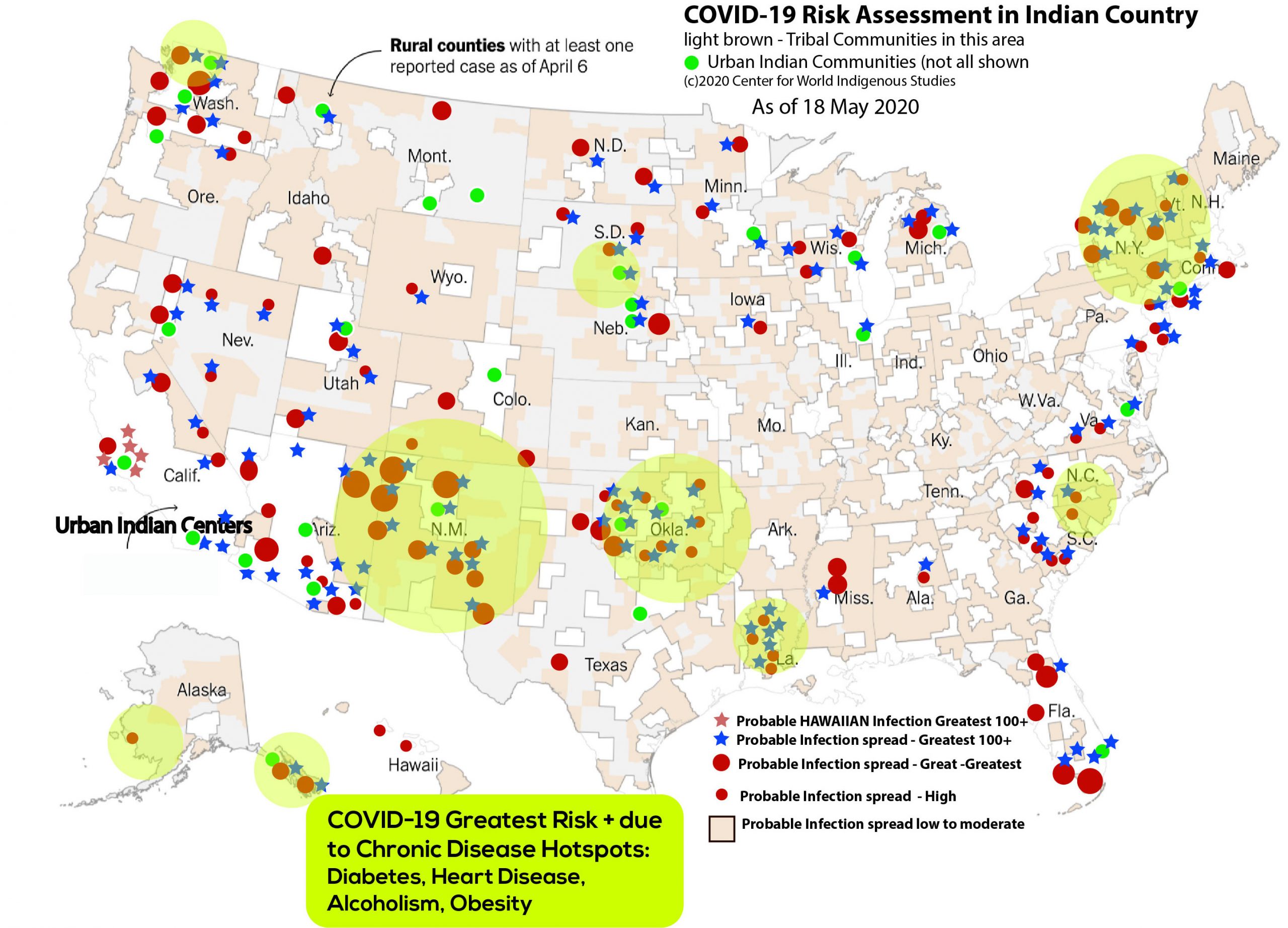
Map updated to May 18, 2020
Downloadable Resources
- 260-532 18 May 20 COVID-19 Indian Cntry Risk Assessment [FF]
Download here - 260-532 8 May 20 COVID-19 Indian Cntry Risk Assessment [FF]
Download here - 260-532 1 May 20 COVID-19 Indian Cntry Risk Assessment [F]
Download here - 260-532 24 April COVID-19 Indian Cntry Risk Assessment [FF]
Download here - 260-9 Best Practices 24 April 2020 COVID-19
Download here - 260-532 17 April COVID-19 Indian Cntry Risk Assessment
Download here
*Support for the “Indian Country COVID-19 Pandemic Risk Assessment” has been provided by Humanities Washington and the National Endowment for the Humanities to advance the COVID-19 Pandemic Risk Assessment
CWIS Actions
- Action Item 1: Documentation and Reports of Best Practices, tracking infections and deaths, and the application of traditional medicine and healing for prevention and mitigation of the virus to prevent, manage, and treat COVID-19 infections in tribal communities and urban Indian communities.
- Action Item 2: Develop Public Health and traditional medicine guidance, reports and recommendations to sustain individual, family, community, emotional and biological resilience, mental health and strong immune function supported by nutritional factors. Public Health Practices identify assess and specify by community if possible vulnerabilities.
- Action Item 3: Reach out directly to tribal individuals and communities through communications, content narratives, scripts, and distribution produced in part by the CWIS team and with partners including the FNX Indian Television Network, and Native Public Media reaching the vast majority of the 574 tribal communities and 42 urban Indian communities.
Recent News
Learn more about the news and actions that CWIS will carry out